

Overload protection for motors
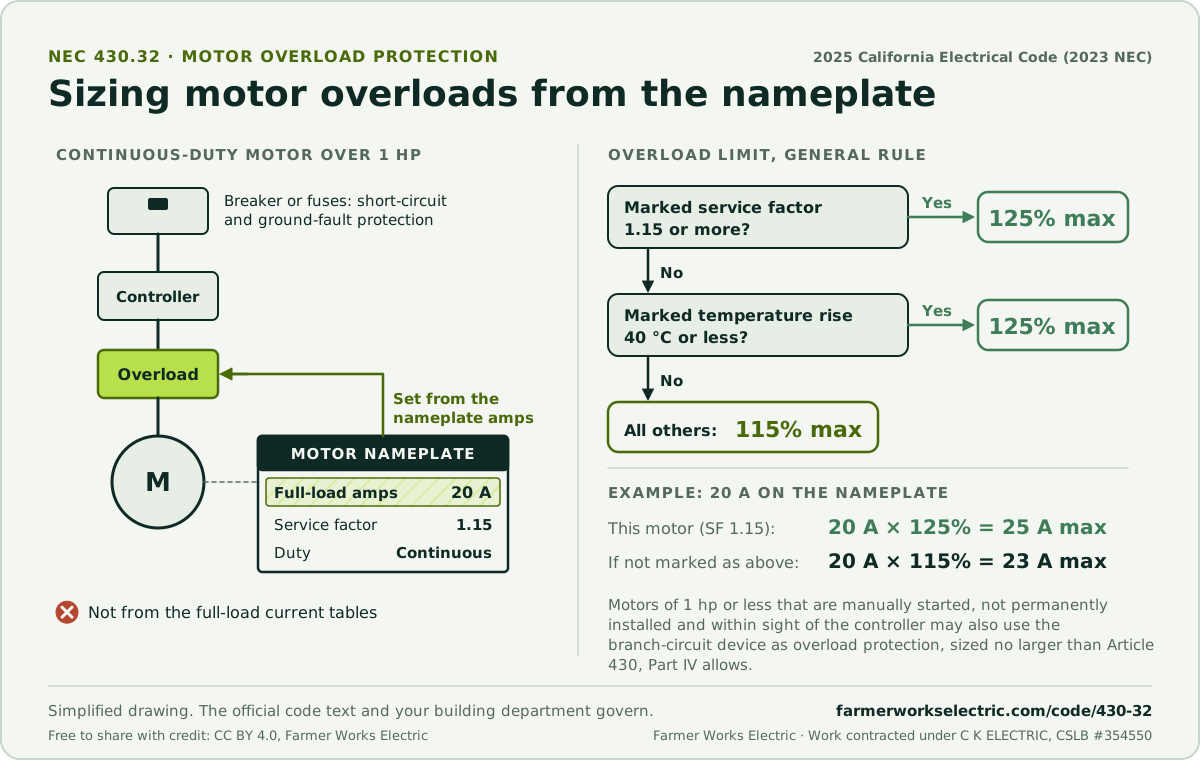
A continuous-duty motor over 1 hp needs overload protection, usually a separate overload device sized from its nameplate current: generally no more than 125% with a service factor of 1.15 or more or a temperature rise of 40 °C or less, 115% for others.
What the code requires
A continuous-duty motor rated more than 1 hp must be protected against overload in one of four ways: a separate overload device; an approved thermal protector built into the motor, or approved electronic protection; a protective device built into a motor that is part of an approved assembly that does not normally overload it; or, above 1500 hp, embedded temperature detectors. A separate device is generally selected at no more than 125% of the motor's nameplate current when the motor has a marked service factor of 1.15 or more, or a marked temperature rise of 40 °C or less. For all other motors, the limit is generally 115%.
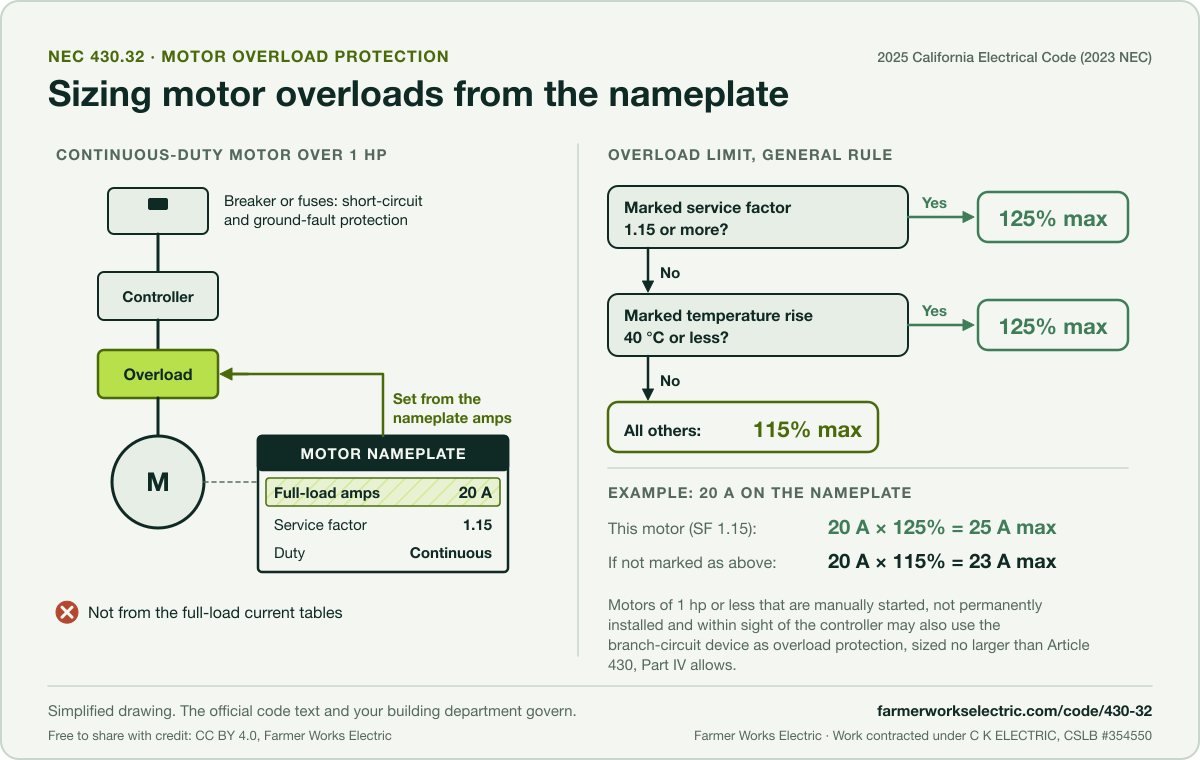
Overload devices are sized from the current on the motor's nameplate, not from table full-load current values.
For a motor of 1 hp or less that is manually started, not permanently installed, and within sight of its controller, the branch-circuit short-circuit and ground-fault protective device may also provide overload protection. That device can be no larger than Part IV of Article 430 allows.
On the job
- Overloads set from table full-load current instead of the motor nameplate are a common error.
- Separate from 430.32, NFPA TIA 23-20 (effective Sept 9, 2025) adds 430.132, which prohibits GFCI or SPGFCI protection between power-conversion equipment and motors. California may print the code without later TIAs, so confirm with your building department.
Exceptions that matter
- A small motor meeting the conditions above is acceptable on a 120-volt circuit protected at not over 20 A.
- If the small motor is not within sight of its controller, overload protection must follow 430.32(B) instead.
Related sections
- NEC 430.6(A)(2)
- NEC 430.52
- NEC 430.55
- NEC 240.6(A)
- NEC 430.132
Where this comes from
Send a photo. Get a real answer.
Text is fastest, and a photo quote is free. Call if it is urgent, if you smell something burning, or if a breaker will not reset.
Electrical work contracted under C K ELECTRIC · CSLB Lic. #354550 (C-10) · Farmer Works Electric license in process